
DID GTA 6 REALLY COSTTwo billion
dollars?
A spectacular world. A very specific number.
Follow the claim back to the evidence.
Did GTA 6 actually cost $2 billion?
The $2 billion figure is not verified as GTA VI’s actual development cost by the public sources reviewed for this article. At our October 8, 2026 check, the evidence supports a narrower answer: an outside forecast uses that number, while Take-Two’s financial statements report broader company balances.
That distinction matters. “Unverified” does not mean “proved false,” and it does not mean the game must have cost less. It means we cannot responsibly print a precise final bill from the evidence in front of us. We also cannot replace $2 billion with another eye-catching estimate and call the question settled.
The useful question is not whether GTA VI looks expensive. It is whether a source identifies the cost of this specific game, explains what is counted, and tells us how much had been spent by a particular date. The evidence desk below lets you inspect three numbers that can otherwise get mixed together.
Put the number
back in its file.
Select a document card. Rotate it, inspect its source, then flip it to see what it cannot establish.
An outside forecast
$2 billion · Josh Chapman / KonvoyThe post uses this investment figure in a prediction. It is not a budget statement from Rockstar or Take-Two.
Open the original source ↗Opening paragraph and numbered predictionsOriginal editorial cards, not reproductions of the documents. Every figure is readable below without rotating anything.
Read all three figures without the interactive desk
- $2 billion — An outside forecastJosh Chapman / KonvoyInspect source 01 ↗
- $2.1497B — Unreleased titles, pluralTake-Two / 31 March 2026Inspect source 02 ↗
- $2.431B — Company-wide carrying valueTake-Two / 30 June 2026Inspect source 03 ↗
Where can we trace the $2 billion claim?
One identifiable public example is Josh Chapman’s Konvoy forecast on LinkedIn. It uses a $2 billion investment figure while predicting revenue and recovery of the investment after release. The post describes its broader exercise as predictions. It is an outside forecast, not a disclosure issued by the game’s publisher.
We are not claiming this post invented the number or was its first appearance anywhere. Establishing a rumor’s earliest origin would require a different evidence trail. What this source does show is how a precise-looking cost can sit inside a predictive model, then lose that context when someone repeats it.
An estimate can be thoughtful and still remain an estimate. Its author’s confidence, the popularity of the post and the precision of the figure do not convert it into an audited development total. When sharing it, keep the attribution attached.
Take-Two’s balance sheet
is bigger than one game.
A balance at a date.
36.0 current + 2,395.0 non-current
share?Not specified
in this table
Bars start at zero; common maximum $2,500m. The $84.7m difference is a change in carrying value, not a measure of quarterly cash spending.
Read Note 7 in the June 2026 Form 10-Q ↗Open the accessible data table
| Date | Current | Non-current | Our sum |
|---|---|---|---|
| 31 March 2026 | 68.8 | 2277.5 | 2346.3 |
| 30 June 2026 | 36.0 | 2395.0 | 2431.0 |
The June 2026 quarterly filing presents consolidated figures. Adding its current and non-current software development and licensing rows does not reveal a title-by-title allocation. A total near a viral budget claim is not evidence that the two describe the same thing.
What does “capitalized” mean here?
Take-Two’s annual accounting policy describes qualifying development costs being recorded as assets after technological feasibility. Earlier development costs are expensed. Amortization begins when a product is generally released; impairments and certain grants can also affect carrying values. This helps explain why a reported asset balance is not simply a lifetime cash-spending counter.
The distinction is easier to see as three different camera angles. A balance sheet is a snapshot at a date. An income statement covers income and expenses over a period. A cash-flow statement tracks movements of money. The SEC’s guide to financial statements explains these separate views.
on the books?Balance at a date
or expensed?Income statement
or went out?Cash-flow statement
Before drawing a conclusion from an accounts screenshot, preserve the table heading, units, column date and explanatory note. Removing those labels can make a real number tell a story its source never told.
Four checks before
you share the headline.
An estimate needs its author.
A forecast can be worth reading. Retain the forecaster’s name and assumptions when sharing it; do not turn it into an announcement by Rockstar.
Development, marketing and a lifetime plan are different questions
Imagine two otherwise identical reports. One says a game has a development budget. The other says a project has an investment plan including advertising and years of support. Even if both use the same dollar amount, they are answering different questions. This is an illustrative example, not a description of Rockstar’s internal accounting.
“Budgeted,” “committed” and “spent” also make different claims. A plan for future spending cannot automatically be described as money already spent. Nor can the cost of one legal entity automatically become a worldwide project total. You would need evidence showing how costs were allocated and whether transfers between entities create duplication.
This is why our conclusion stays deliberately narrow. We can identify what the inspected sources say. We cannot fill missing allocations with guesses about staff numbers, salaries, years of development or the cost of every frame of a trailer.
Twenty-five million copies.
But whose $80?
Try a hypothetical $2 billion cost and $80 per copy. Then change the money retained per sale. The missing assumption becomes visible.
Change an assumption.
Watch the answer move.
These inputs are invented teaching assumptions. $80 is a round example, not a store quote. Nothing here estimates the publisher’s actual share.
40,000,000 whole copies, rounded up
If all $80 were retained: 25.00M copies.
This is not a profitability or break-even forecast.Dividing an assumed $2 billion by an assumed $80 produces 25 million copies. That arithmetic is correct. Calling it GTA VI’s actual break-even point would require much more: a verified cost, what the publisher retains, and consistent treatment of other expenses and income.
If our fictional example retains $50 instead, the same division gives 40 million copies. We are not asserting that $50 is Take-Two’s share. The example demonstrates sensitivity to an input people often leave unstated. Retail prices, publisher receipts and profit should not be used interchangeably.
The tool deliberately does not forecast demand, subscription revenue, online spending, discounts or a date when a real investment will be recovered. Its answer is only the number of hypothetical sales needed to match the assumed cost at the selected retained amount. For the actual listed purchase prices, use our GTA VI price and editions guide.
You can see the world.
You cannot see its invoice.
Our official extended-look guide helps you check footage in its original context. Visible detail can support a discussion of what is shown; it does not reveal a development invoice.
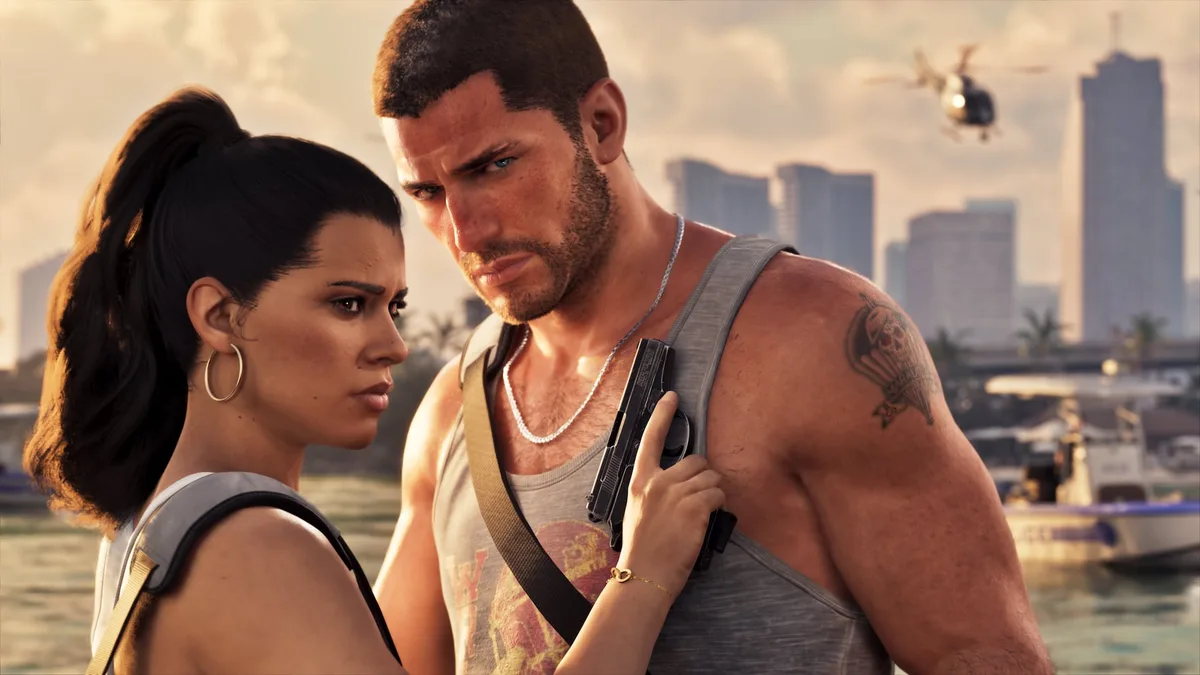
Official Trailer 2 · 6 May 2025. Footage shows the creative work, not its production cost. The trailer’s old launch date was superseded; see our current release guide.
The player connects to YouTube only when loaded. Playback may depend on your browser and region.
What can we responsibly say about GTA 6’s budget?
Is the $2 billion claim definitely false?
No. The evidence reviewed does not establish it as the actual cost. Lack of public confirmation does not prove a smaller budget or disprove every possible definition of a $2 billion investment.
Does a billion-dollar company balance confirm a billion-dollar game?
No. You need an allocation to the named game. The same table can contain costs associated with multiple products and licenses.
Can we call GTA VI the most expensive game ever?
We cannot establish that ranking from these sources. A fair comparison would need verified title costs measured on the same basis, with consistent treatment of marketing, support and currency.
Would a higher budget guarantee better gameplay?
A budget figure does not measure how driving feels, how missions work or how well a game performs. Those claims need gameplay evidence and, where appropriate, reproducible testing.
What would change this article’s conclusion?
An attributable Rockstar or Take-Two disclosure naming GTA VI’s cost, its currency, the spending period and what is included. We would check the original statement and revise the finding, retaining the distinction between a forecast and actual spending.
The next time a precise budget appears in your feed, open its source before admiring its size. Follow the number through the author, scope and date. If one of those disappears along the way, keep the qualification attached to the claim.
A claim should
come with a trail.
We checked the annual filing, the later quarterly filing, the original public forecast and the official game material. Our conclusion is limited to these publicly accessible sources.
Prepared with AI assistance. No access to Rockstar’s internal budgets is claimed. The calculator is original explanatory arithmetic, not investment analysis.
Send a correction with a primary source ↗- 01Take-Two FY2026 Form 10-K — Note 7 and accounting policy ↗
- 02Take-Two June 2026 Form 10-Q — Note 7 and balance sheet ↗
- 03Josh Chapman / Konvoy — original public GTA VI forecast ↗
- 04U.S. SEC — how balance sheets, income and cash flows differ ↗
- 05Rockstar Games — official GTA VI Trailer 2 ↗
- 06Rockstar Games — official screenshot gallery ↗