GTA VI / FREEDOM & THE STORY
YOUR
MISSION.
YOUR
WAY? GTA 6 mission freedom explained
You know where the story needs to go.
How much of the journey belongs to you?

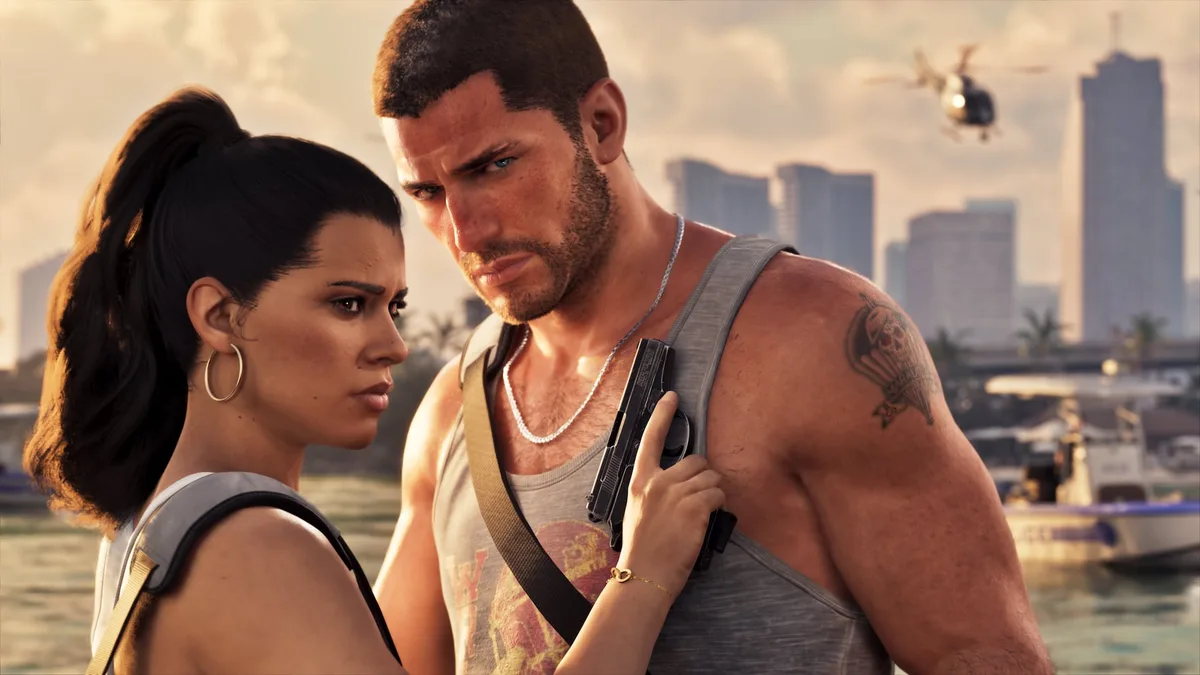
MORE THAN ONE LINE.Official image © Rockstar Games
Route overlay: original illustration
The turn you want
to take.
A mission gives you a destination. The interesting moment comes when you see another way to reach it—and wonder whether the game will let you.
GTA VI’s mission design is in the news after GamesRadar+’s October 8 report ↗ on Rob Nelson’s IGN interview. The report describes an effort to allow more approaches where possible, while keeping some sequences directed to serve the narrative.
Its examples include alternate exits from a tower block and a chase where the suggested route is not the only workable one. Nelson also describes an aim for mission use of systems such as wanted levels to remain consistent with free roam. These are attributed developer comments, not our hands-on findings.
More room to choose a route does not, by itself, establish unlimited mission freedom. The useful distinction is between how you reach a scene and whether your choice changes what the scene is.
For players, that distinction is more useful than a sweeping promise about “total freedom.” It tells you what to look for: a direction you can reconsider, an objective that remains understandable, and a response that makes sense after you try something else.
Take another line.
Keep the meeting.
Choose a path, move through a miniature city and lift its architecture out of the way. The story’s bookends stay put while your journey changes.
One meeting.
Your way there.
Loads only when you choose · no game download
ROUTE POSITION
The middle path stays close to the buildings. A different journey can still arrive at the same meeting.
Invented architecture, paths and pacing. No GTA VI geometry, mission layout or measured travel time. The diagram is an explanation of route choice. Playing a journey animates this illustration for 16 seconds; it predicts nothing about the game.
A model you can take apart.
The exercise is deliberately ordinary: leave one place and meet someone at another. Choose the arcade, courtyard or waterside path. Move the marker by hand, watch a short journey, or drop to street level to inspect the space from a different angle.
Lift the buildings and the relationship becomes obvious. The paths differ; the start and meeting point do not. This is an original architectural illustration, not a reconstruction of any mission mentioned in the reporting.
What changed when you chose?
You changed the journey’s geometry. You did not choose a new person to meet, a different reason for meeting or a different consequence afterward. Those would be separate kinds of choice, and a good explanation should name them separately.
Try the longest-looking route, then return to the middle path. The model has no reward for taking more time. It makes a smaller point: a choice can feel distinct without multiplying the story’s outcomes.
“Freedom” needs
a second word.
Our framework for reading mission coverage. These categories describe questions to ask, not four promised GTA VI features.
Route freedom
Can you get to the objective another way?
A different street can still lead to the same scene.Approach freedom
Can you solve the same problem by a different method?
A change in method needs evidence beyond a change of road.Story freedom
Does your decision change what happens afterward?
Multiple paths do not automatically mean branching endings.System consistency
Do comparable actions receive understandable responses?
Compare conditions, not just how two clips look.A fixed scene can give a choice meaning.
A narrative gives a player something to care about before asking them to choose. If you do not understand the destination, an extra path can be just an extra path. If you understand why you need to arrive, deciding how to get there becomes part of your relationship with the scene.
In LOVE’s direct interview with Rockstar ↗, Nelson describes an experience-led balance between realism and convenience. He also explains that early development includes plotting major story beats on a map. That is useful context: place, narrative and the player’s experience are developed together.
Our reading is that the most revealing question is not whether direction disappears. It is whether the game makes the boundary between authored scenes and player initiative feel coherent. That is an evaluative question for playing the finished game, not a conclusion we can draw from an interview alone.
For the people at the centre of that narrative, read our introduction to Jason and Lucia . For the setting around them, our Vice City and Leonida guide separates the named locations from speculation about map layouts.
The meaning of a choice is a separate question from the route you take. Our American-dream feature explores what a better life might mean through Rockstar’s interview, official character context and an original interactive miniature home.

No mission route identified in this image.
A better question
at every junction.
Follow a claim back to what supports it. An encouraging example still has a boundary.
OF PATHSWhat follows
from that?
More ways through a mission
GamesRadar+ reports Nelson’s explanation that Rockstar is opening up missions where possible. Keep that qualification attached.
Read the relevant source ↗Why an alternate exit matters.
Consider a fictional mission where the next scene must begin with two characters meeting. If the player can choose a route and still arrive, the scene retains its purpose while the journey becomes less prescribed. That is a design possibility our model explains—not a count of how often GTA VI does it.
A second path becomes meaningful when a player can recognise it as an option. Visibility, navigation cues and the way a companion speaks could all matter to that experience. Here those are analytical questions, not claimed details of Rockstar’s implementation.
A route also has consequences after a mission starts. Our GTA VI wanted levels and Heat report uses an interactive sightline model to distinguish breaking visual contact from changing what a pursuer knows.
Why one example has limits.
To test a universal claim, you would need much broader evidence than one sequence. An alternate turn in a chase cannot tell you what happens when a player abandons a companion, misses a required event or leaves an entirely different mission area.
Likewise, an on-screen objective is not enough to establish every condition behind it. The appropriate conclusion should stay close to what was actually demonstrated or explained.
A suggested path and a compulsory path are different ideas. The important question is whether the game continues to recognise your objective after you leave its preferred route. The reported examples are encouraging; they are not a promise about every instruction.
Our explanation of how to read the evidence.The best follow-up is specific.
Instead of asking whether a game is completely free, ask whether a particular choice is recognised. Name the objective, the alternate action, the response and the conditions under which it happened. Those details make an observation useful to somebody else.
The same discipline applies to our report on pedestrian-dialogue writers : the existence of a writing team tells us something valuable, but does not describe every underlying interaction system.
A story about mission design also does not supply hardware measurements. If your next decision is whether to buy or upgrade a computer, use our GTA VI PC release and specifications feature to keep that evidence separate.
Keep your eye
on the choice.
Watch for the objective, the change in action and the response. Keep the source close to the interpretation.
This official video is age-restricted on YouTube. Use the direct link for playback; the optional embedded player may be blocked. YouTube connects only after you load it. The poster is official artwork, not an identified video frame.
Start at the official upload.
Rockstar’s An Extended Look page ↗ dates the presentation to August 27, 2026 and describes it as captured from in-game footage on PlayStation 5. The YouTube player above uses the upload linked from that official page.
That establishes the presentation’s provenance and stated capture platform. It does not turn our route model into a measured reconstruction, or let us infer unshown mission rules. Our extended-look guide provides a direct starting point for the longer material.
Separate the edit from the experiment.
A cut can conceal an input, a failed attempt or a change in conditions without being deceptive; an edited presentation has a different job from a controlled test. Watch it for what it actually shows.
When footage appears to demonstrate a choice, note whether the action and its consequence remain in one continuous sequence. If they do not, keep the gap visible in your explanation. A careful description is more useful than filling that gap with an attractive theory.
When you leave the line,
does the story
come with you?
That is what makes this discussion worth following. The experience is not only about the number of roads you can take. It is about whether your choice feels understood when you arrive.
For now, the reporting gives us a focused design ambition to watch. The finished game will have to supply the experience.