
GTA VI · NPC DIALOGUE & WORLD BUILDING
A CITY
WORTH
LISTENING
TO. GTA 6’s pedestrian-dialogue writers and what their work tells us
The next thing that pulls you into Leonida
might be a conversation you almost walked past.
LOOK.
LISTEN.Original waveform artwork
Not a recording of the game
Sources checked · Approx. 10 min read
Published Official GTA VI image © Rockstar Games
Independent reporting & original interactive illustrations
Who writes the people
you walk past?
Rockstar has a dedicated team writing pedestrian dialogue for GTA VI. The interesting question is what that work can contribute to the feeling of being somewhere.
In Kacion Mayers’ LOVE interview, dated October 5, Rockstar’s senior vice president of narrative, Rupert Humphries, identifies a Los Angeles pedestrian-dialogue team, alongside advertising and comedy writers in New York, Los Angeles and London. He treats those contributions as part of the game’s world, rather than incidental decoration.
The topic received fresh coverage from GamesRadar+ on October 11. Its report also attributes to open-world writing director James Horton an ambition for conversations to hold up both while a player passes through and when they stop to listen. That Horton passage is secondary reporting here: it does not appear in the accessible LOVE excerpt we reviewed.
The interview establishes a writing commitment. Our analysis explores the difference between noticing a scene and learning how its underlying systems work. The exhibits below are original teaching tools; we have not played a review build.
A street has more than one centre.
Think about the way you first enter a new game world. You might follow an objective, study a shopfront, turn toward a sound or stop because two people appear to be having a moment that does not involve you. Those are different ways of paying attention to the same space.
For this article, that is the useful lens: what does the scene offer when your attention shifts? A detail can be easy to miss without being unimportant. A conversation need not become a quest to give you a reason to remember a corner.
That is our reading of the creative ambition, not a promise about every encounter. To see why the distinction matters, step into a small model built specifically for this story.
Move through it.
Then choose a layer.
A sculptural street section about attention. Move the listener, lift into the schematic minimap, and isolate three kinds of world-building.
Loads on demand · sound off · move at your own pace
Move along the path, then isolate a layer. The heights, colours and levels are our visual model; they do not measure the game.
Optional, quiet synthetic tones move between stereo channels. No game audio, voices or music. Sound mutes when the exhibit leaves the screen.
Original code-built sculpture and schematic minimap. Architecture, distances, layer placement and attenuation are invented for this explanation. This is not GTA VI gameplay, a map reconstruction or a simulation of Rockstar’s audio engine.
What the model is doing.
The slider moves a listener along a straight, invented path. Each sculpture stands for a category of material. The model changes a simple proximity value as the listener moves; isolating one layer lowers the other sculptures and mutes their optional tones.
There is no hidden game data behind the controls. The sound is a set of synthetic notes, the geometry is ours, and the three positions were chosen to make the explanation legible. You can understand the full argument with the sound off or the 3D view closed.
What would make it a game claim?
To describe GTA VI’s actual behavior, we would need evidence from that behavior: attributable footage, a precise developer explanation, or repeatable observations from a playable build. A graceful web animation supplies none of those.
For the music and broadcast side of the world, continue with our GTA VI radio, songs and hosts coverage . That article answers a different question from how the writing around a passerby works.
How much of a moment
do you give yourself?
The same short scene offers a different opportunity when you stop, walk, run or pass in a car. Change the assumptions and inspect the result.
Same street.
Different window.
Select a pace. Watch the amount of a short thought you could encounter change.
23 / 23 words exposed in this simple model.
Calculation: zone length ÷ speed, with a made-up reading rate of 2.5 words/second. The sentence is ours. Speeds, range and timing are illustrative—not GTA VI measurements, subtitles or audio behavior. Stopping removes the travel limit; it does not imply endless game dialogue.
Time in range is only the beginning.
In our example, a twenty-metre zone crossed at 1.4 metres per second gives roughly 14.3 seconds inside it. Crossing at 13.9 metres per second gives about 1.4 seconds. That is arithmetic applied to our assumptions. Neither number measures a character or car in GTA VI.
The experiment makes one limited point: a moving observer has a changing opportunity to attend to something. It does not tell you whether a conversation starts on approach, was already underway, waits for the player or continues after they leave. Those are implementation questions, and the writing-team news does not answer them.
It also leaves out the most human part: attention is a choice. A player can stand near a conversation and look elsewhere. A passing phrase can make somebody turn around. The quantity of speech and the significance of a moment are not interchangeable measures.
Realism has a purpose.
In the LOVE interview, Rockstar North’s Rob Nelson describes balancing realism with the player’s experience, including when too much realism becomes tedious. LOVE · Kacion Mayers interviews Rockstar Games ↗
For our analysis, a useful question follows: does a detail make the scene understandable and worth spending time in? A long wait, an elaborate routine or a dense soundscape is not automatically a better experience simply because it is more complicated. How these choices feel will need to be judged in play.

Some people lead the story.
Others make it a place.
Rockstar’s official character overview introduces Jason Duval and Lucia Caminos as the central pair. It also describes a wider cast: Cal Hampton, Boobie Ike, Dre’Quan Priest, Real Dimez, Raul Bautista and Brian Heder. Those named profiles are distinct from the pedestrian-writing team discussed in this report. Rockstar Games · Only in Leonida ↗
A named character’s biography cannot be used as a specification for every person in a crowd. Equally, seeing a figure in a screenshot does not tell us whether they can be approached, what they say, or how their behavior changes after an encounter.
Our Jason and Lucia introduction follows the protagonists; our Vice City and Leonida guide keeps the setting in view. They are useful companions when a conversation about “NPCs” starts mixing the main cast, ambient pedestrians and the world itself.
A great detail.
How far does it go?
Choose a claim. The source map separates the reported fact, the creative aim and the technical questions that remain open.
THE STORY
ESTABLISH?
The writing team
Humphries describes a dedicated pedestrian-dialogue team in Los Angeles.
That establishes an area of authorship. It does not count lines, actors or pedestrians.
Read the attributed source ↗Does this mean NPCs remember everything?
That conclusion needs its own evidence. A conversation can be convincing on a first encounter without establishing what persists across visits, sessions or different parts of the story. To evaluate a memory claim, begin with a precise action and a precise later response.
For example, the question would be whether a particular response changes after a documented earlier interaction, with other conditions controlled. One reaction in an edited clip cannot describe the rules for every pedestrian.
Does “alive” mean unrestricted conversation?
“Alive” is a description of an experience, not a technical specification. It does not identify an input method, a dialogue-generation architecture, an internet requirement or the number of responses. Avoid filling those gaps with whatever technology is currently fashionable.
Our standard is straightforward: a claim about a particular system needs a source that actually discusses that system. The existence of a writing team should not be stretched into a claim that a player can say anything to anyone.
An editorial checklist, not Rockstar’s production diagram. Evidence about one stage does not automatically establish every stage after it.
Can this tell us the PC requirements?
No reliable component recommendation follows from this story. A staffing detail, a character biography and an atmospheric trailer are different kinds of information from measured performance. The news does not supply a PC release schedule, CPU requirement or frame-rate result.
If your real question is whether to upgrade, use our GTA VI PC release-date and specifications feature . If it is when you can play on an announced platform, our release-date briefing keeps the current schedule and platform wording together.
Let the footage
ask better questions.
The official second trailer gives you material to inspect. The checklist below helps keep observation separate from inference.
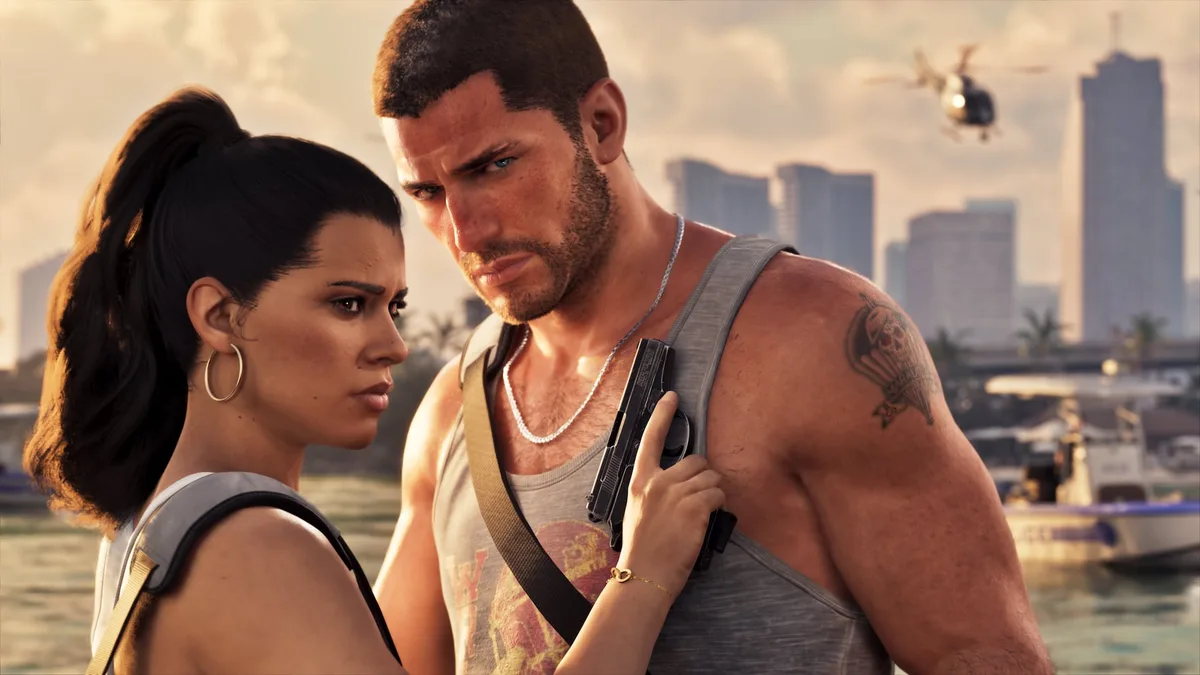
Watch the original footage. A trailer is edited material; it cannot settle how an unscripted encounter behaves across repeated play.
Open on YouTube ↗YouTube connects only after you load the player.Watch once for the scene. Again for the evidence.
Rockstar dates Trailer 2 to May 6, 2025. Its published synopsis places Jason and Lucia in a conspiracy across Leonida after a job goes wrong. It is official presentation material, not this publication’s gameplay capture. Rockstar Games · Trailer 2, May 6, 2025 ↗
On a first viewing, let the scene work. On another, be specific about what you can actually describe. Is a person addressing a protagonist, somebody nearby or a recording device? Is the response shown in the same continuous shot? Does a cut leave the sequence of events uncertain?
A trailer can be excellent at conveying tone while leaving these questions unresolved. Mark that uncertainty instead of drawing a system diagram from the edit. Our official extended-look guide provides another route back to the longer material.
Watch with
better questions.
This notebook tracks your reading approach. It does not rate the game or save personal data.
0 / 4 checked The smallest story
may be the one
you decide to stay for.
There is a useful way to carry this news into the next piece of footage: look for what makes a place particular. A character’s response, a sign, a broadcast or a detail you nearly missed can become the thing you remember.
Whether GTA VI consistently delivers that feeling is a question for the finished experience. For now, the reporting gives us a more specific area to pay attention to—and a reason to slow down when we eventually get there.
The fiction extends beyond people, too. Our newly published Vice City Collection feature examines the real merchandise built around Leonida’s fictional consumer culture, with official product imagery and a separate 3D inventory.
For the choices that shape your journey through that world, read our GTA VI mission-freedom report. An original 3D route model explains why taking another path and changing the story are different questions.